
Science NHS journal
The Hidden Geometry of Soap Bubbles
Soap bubbles form round shapes because their elastic films continually pull toward the smallest possible surface area. This journal explains how surface tension, air pressure, and shared walls shape bubbles on their own and in clusters.
About this journal
The story behind the work.
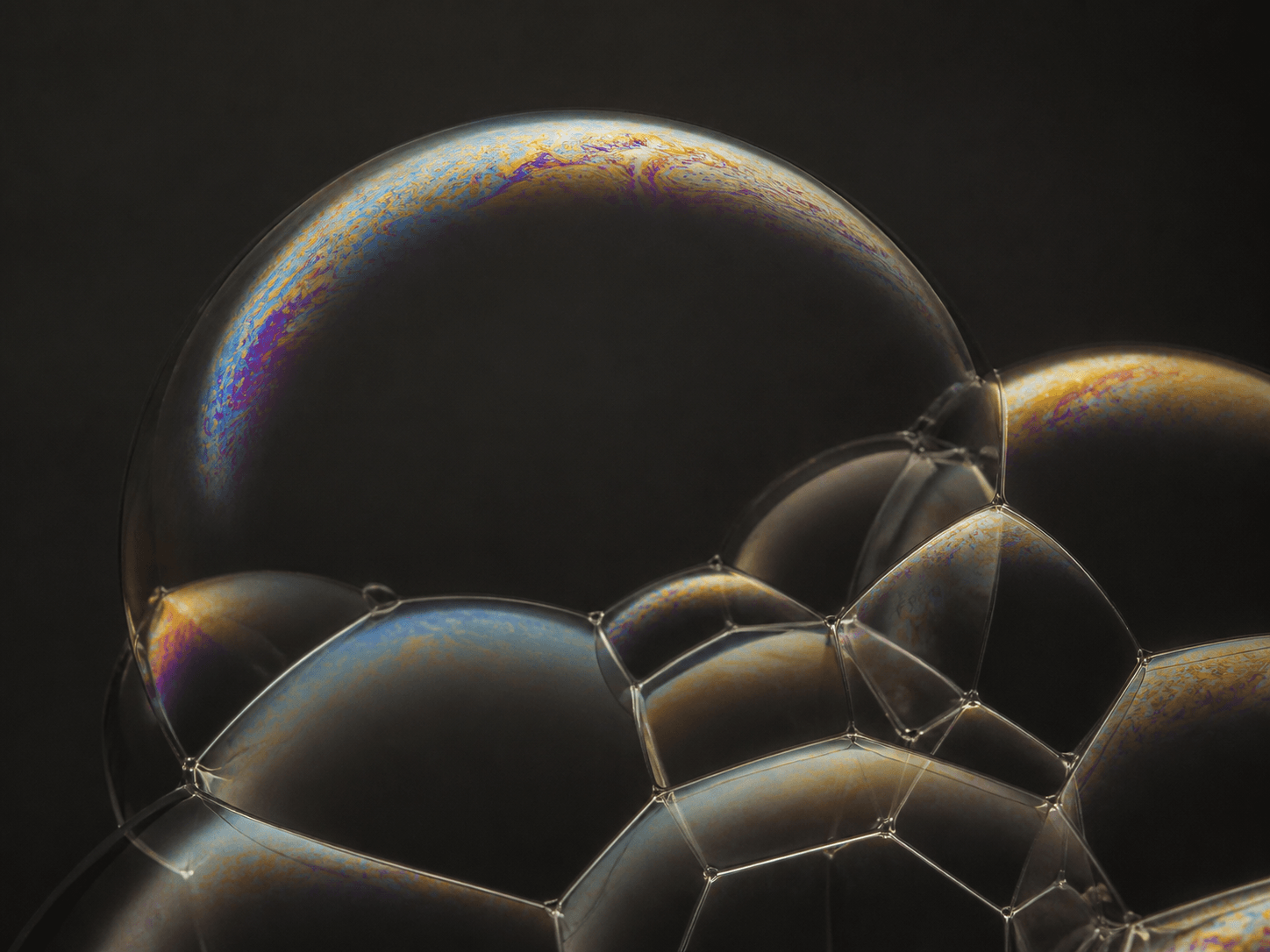
Soap molecules organize into thin films that pull inward from every direction. For a single bubble, a sphere encloses the most air while using the least surface area, so it becomes the most efficient shape. Air pressure inside the bubble pushes outward until it balances the inward pull of the film. When bubbles meet, they share flat or gently curved walls because the pressures on each side interact. These simple rules create the surprisingly orderly patterns seen in bubble clusters.
The original PDF is text-searchable but untagged. Use the HTML edition above for structured headings, lists, and table navigation.
Accessible HTML edition
The Hidden Geometry of Soap Bubbles
A soap bubble looks simple, but its shape reveals a powerful rule: nature often settles into the arrangement that uses the least energy. Surface tension pulls the soap film inward while the air inside pushes outward. When those forces balance, a round bubble forms.
Why round wins
Molecules in a soap film attract one another. At the surface, that attraction behaves like a stretched skin called surface tension. The film continually tries to shrink. A sphere is the shape that lets it enclose the bubble's air with the smallest surface.
- 01
Least surface, most space
For a fixed amount of enclosed air, the sphere uses less film than any other shape.
- 02
Pressure balances pull
Air pressure pushes outward while surface tension pulls inward. Smaller bubbles have greater internal pressure than larger bubbles.
- 03
Clusters negotiate shared walls
Touching bubbles share a film to reduce total surface area. Where three films meet, they usually form angles close to 120 degrees.
What the colors mean
A soap film is only a thin layer of water between soap molecules. Light reflects from both its outer and inner surfaces. Those reflections reinforce or cancel different wavelengths, producing shifting colors. As liquid drains and the film thickness changes, the color pattern changes too.
Observation activity
Watch geometry assemble itself
This is an observation, not a competition. Make a small cluster and record how its shapes, shared walls, and junctions change.
Materials
- a shallow plate;
- one-half cup of water;
- one tablespoon of dish soap;
- a clean drinking straw; and
- a towel for spills.
Method
- Mix one tablespoon of dish soap into one-half cup of water without making foam.
- Spread a thin film of the solution across the plate.
- Dip one end of the straw in the solution and gently blow one bubble.
- Add two or three bubbles and watch how the shared walls change.
- Sketch the cluster and mark the places where three films meet.
| Stage | Shape noticed | Shared walls | Junctions |
|---|---|---|---|
| One bubble | Record the outline | None expected | Record what you see |
| Two bubbles | Compare both outlines | Describe the shared film | Record what you see |
| Small cluster | Sketch the cluster | Count or describe them | Mark three-film meetings |